Be it a mighty skyscraper or an ancient monument, everything has been intricately shaped by architects with the available toolsets. One of the greatest transformations that gradually shifted manual sketching on drawing boards to digital precision is the CAD software. It evolves like nature, through patterns and intelligence. It is the seed that sprouted digital design. AI and Automation act like the sunlight and rain, speeding up growth, expanding innovative horizons, and transforming the architectural ecosystem.
CAD has significantly eliminated manual processing. With the powerful convergence of AI and Automation, CAD software is now revolutionizing the way architects build, visualize, and deliver projects. This transformation promises to deliver designs that are not only precisely functional but also sustainable, data-driven, and intelligent than ever before. In this blog, we will explore the future prospects of CAD in architecture with AI and automation.
Transition From Drawing Boards to Smart CAD
In the field of architecture, conventional CAD software has made significant advancements from manual paper drawings to advanced digital tools with precision, speed, and increased visualization.But, with the demand for AI skyrocketing, CAD is evolving into an intelligent tool that is capable of making informed decisions, learning from patterns and datasets, and helping professionals in sophisticated challenges.
Earlier, it was a digital sketchpad, but with the integration of AI, it has developed into professional CAD software, understanding the intent of the design, suggesting alternatives, and automating redundant tasks. This allows professionals to focus more on innovation and creativity rather than spending an exponential amount of time in manual processing.
The Role of AI in CAD Architecture
AI fosters robustness in a normal CAD software by bringing predictive intelligence, pattern recognition, and refinement capabilities. Some of the major ways AI is redefining CAD in architecture are:
- Generative Design: With AI-powered generative design, users can enter certain prompts, such as occupancy requirements, budget constraints, environmental factors, etc., to automatically generate various design options. Advanced software solutions such as AutoCAD 2026 have the capability to assess numerous possibilities in a fraction of a second, thus helping architects to identify the most feasible solution.
- Automation of Repetitive Tasks: Complex tasks that once required human effort, such as dimensioning, rendering, and annotation, can now be automated easily. This significantly reduces human errors and maintains standardization across various projects.
- Informed Decision Making: AI has the ability to process a large amount of data to make informed decisions. For instance, it readily analyzes energy use and daylighting patterns to fulfill sustainability goals on schedule intact.
- Smart Fault Detection: CAD tools that utilize artificial intelligence technology have the ability to significantly reduce the amount of time required to detect faults, defects, and inconsistencies, resulting in a prevention of costly rework during the construction process—by improving collaboration between professionals and decentralized teams.
- Natural Language Interaction: Contemporary CAD programs have begun to incorporate voice and text-based commands to assist architects in direct communication with the software. * Rather than scrolling through menus, a practitioner cansay, "Show me a diagram with more daylight" and see suggestions instantaneously.
Automation: Restructuring Workflows
AI provides intelligence to traditional CAD software while automation provides efficacy. This incredible combination increases efficiencies in the workflows throughout architectural practice:
- Automated Drafting and Documentation: A professional CAD software can automatically generate construction-related documents, thereby saving hours spent in manual preparation.
- Cloud-Based Collaboration: With projects getting synced automatically, stakeholders are assured that they get access to the updated files, minimizing miscommunication.
- Combination with BIM: CAD’s integration with BIM allows regular updates of the entire project lifecycle.
- Customizable Scripts: Repetitive patterns can easily be automated, such as doors, windows, and grids, to enable faster iteration.
Advantages of AI + Automation in CAD Architecture
- Improved Creativity: With AI eliminating the load of routine work and repetitive tasks getting automated, architects can freely focus on creativity and innovation. This also allows them to experiment with different designs.
- Enhanced Accuracy and Quality:Machine Learning algorithms prevent flaws in designs, thus assuring precision in every stage of the project lifecycle.
- Sustainability: AI can be used to measure energy performance, monitor material consumption, and minimize environmental damage. In this way, AI assists sustainability.
- Faster Project Delivery: Projects can be delivered instantly, and still maintain quality, as drafting, documenting, and clash detection are being automated.
What The Future Holds
In the next few decades, CAD will evolve into a collaborative and comprehensive design partner:
- AI-Powered Virtual Assistants: It will be transformed into a digital companion who is capable of providing real-time solutions.
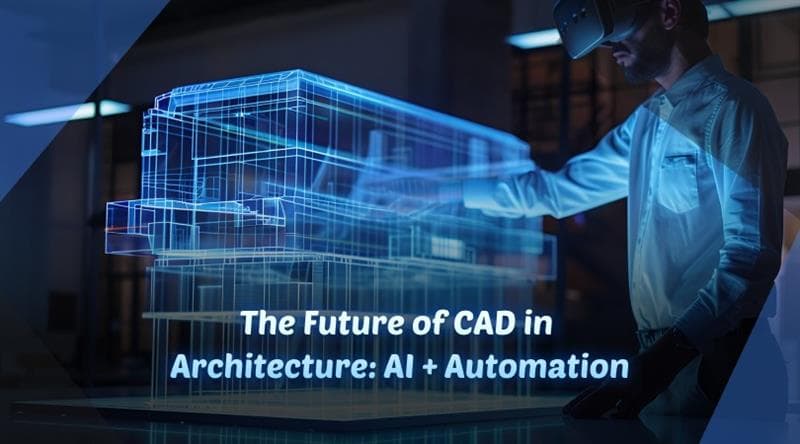
- Integration with AR/VR: With the integration of AR/VR, stakeholders and clients will get the opportunity to walk through the model in immersive environments.
- Robotics and Construction Automation: Designs created in the AI-Powered CAD systems will directly engage with the Architecture construction robots.
- Digital Twins: AI-powered digital replicas of buildings that consistently learn and adapt throughout the lifecycle.
Conclusion
The future of CAD is revolutionizing rapidly with the integration of AI and automation. These technologies are not designed to replace the role of architects; they are just meant to assist them in finding solutions and automate routine tasks. This will ultimately help them to prioritize innovation and creativity.
Today’s rapidly evolving environment is embracing AI-powered insights, sustainability, and smarter decisions. Architects who adopt CAD software, fused with AI and automation, will eventually stay ahead in the competition. This will produce robust models with utmost accuracy and precision.