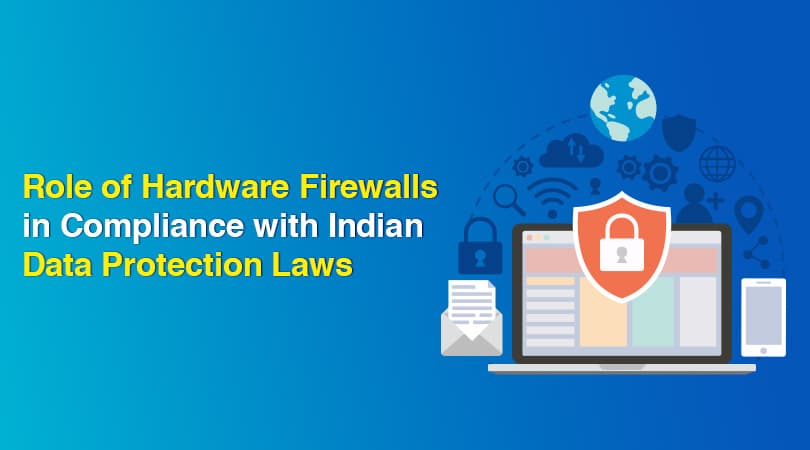
The Digital Personal Data Protection Act of 2023, or simply DPDPA, mandates that reasonable security safeguards be taken by an organization in order to protect the personal data under its custody from being breached. In India, technological progress is accompanied by the need to have strong data protection mechanisms. While the law does not specifically refer to any technologies and procedures for compliance, the significance of doing it through hardware firewalls should not be undervalued.
While a firewall is the first point of contact of each network, it analyzes the traffic entering it and also the traffic flowing out of it. Unlike a software firewall, a hardware firewall functions independently of any device and serves as an actual barricade that separates the internal datacoms from the external entities. The hardware firewall will only let through those packets of data that have been specifically allowed passage according to the standards set.
Why are hardware firewalls important from the perspective of DPDPA compliance?
Reasonable Security Safeguards:
The DPDPA mentions that preventive measures pose reasonable security risks that an organization has to mitigate to avoid personal data breaches. Installing a hardware firewall is a basic standard that exhibits good faith efforts to protect data at the boundary; therefore, it mitigates perimeter network risks. It is a profound measure demonstrating that an organization seeks to prevent data breaches and unauthorized user access.
Preventing Unauthorized Access:
A chief domain of personal data protection is unauthorized access to personal data and restricting such access only to teams and systems that have explicit authorization. Firewalls offer unparalleled network access control. Through proper exit and entry filter configurations, organizations can manage access according to source, destination, port, and protocol. Such practices increase the likelihood of protecting decent and confidential data and reducing the likelihood of exposure to it.
Network Segmentation:
Hardware firewalls can enable internal network segmentation, isolating systems holding or processing personal data from other, less sensitive parts of the infrastructure. A less critical segment breach scenario warns that a firewall will prevent movement to personal data zones, limiting the scope of an incident.
Supporting Data Localization and Geo-Based Restrictions:
India’s data legislative system locates the sprinkle of personal information restriction within the national frontiers, making exceptions only in few situations. Hardware firewalls can block or allow traffic based on country of origin, enforce geo-restrictions for cross-border data transfer policies, and help maintain designated geographic boundaries.
Logging, Monitoring, and Incident Response:
Most enterprise-grade hardware firewalls offer traffic logging and reporting features, real-time alert integration with SIEM tools, and logs for incident investigation and regulatory reporting in case of data breaches, thereby supporting DPDPA's emphasis on accountability and breach response preparedness.
Restricting Access by Vendors and Suppliers:
The DPDPA encompasses third-party service providers and data processors, allowing businesses to limit vendor access on a per-system basis, control external system interactions, and limit third-party risk exposure that is so often exploited for cyber breaches.
Firewalls as Part of a Larger Compliance Strategy:
A firewall is not a standalone solution for full compliance. It is part of a layered security framework that includes IT Security Solutions, Business Cyber Security Software, and Endpoint Security Solutions for Business. These components work together with hardware firewalls to create a Zero Trust architecture, where no entity is trusted by default, both inside and outside the network.
Final Thoughts
A firewall does not provide complete compliance by itself, but it forms part of a critical section in a layered security strategy. Organizations can improve their compliance posture required by the DPDPA when the firewall is used with other IT Security Solutions, business cybersecurity software, and even endpoint security solutions for business.